Wildlife5 min readMarch 12, 2026
How to spot a moose at dawn (and why our back lawn is the easiest place to start)
A short, practical field guide to seeing the largest member of the deer family — without scaring it, or yourself.
By James · Concierge & Grounds
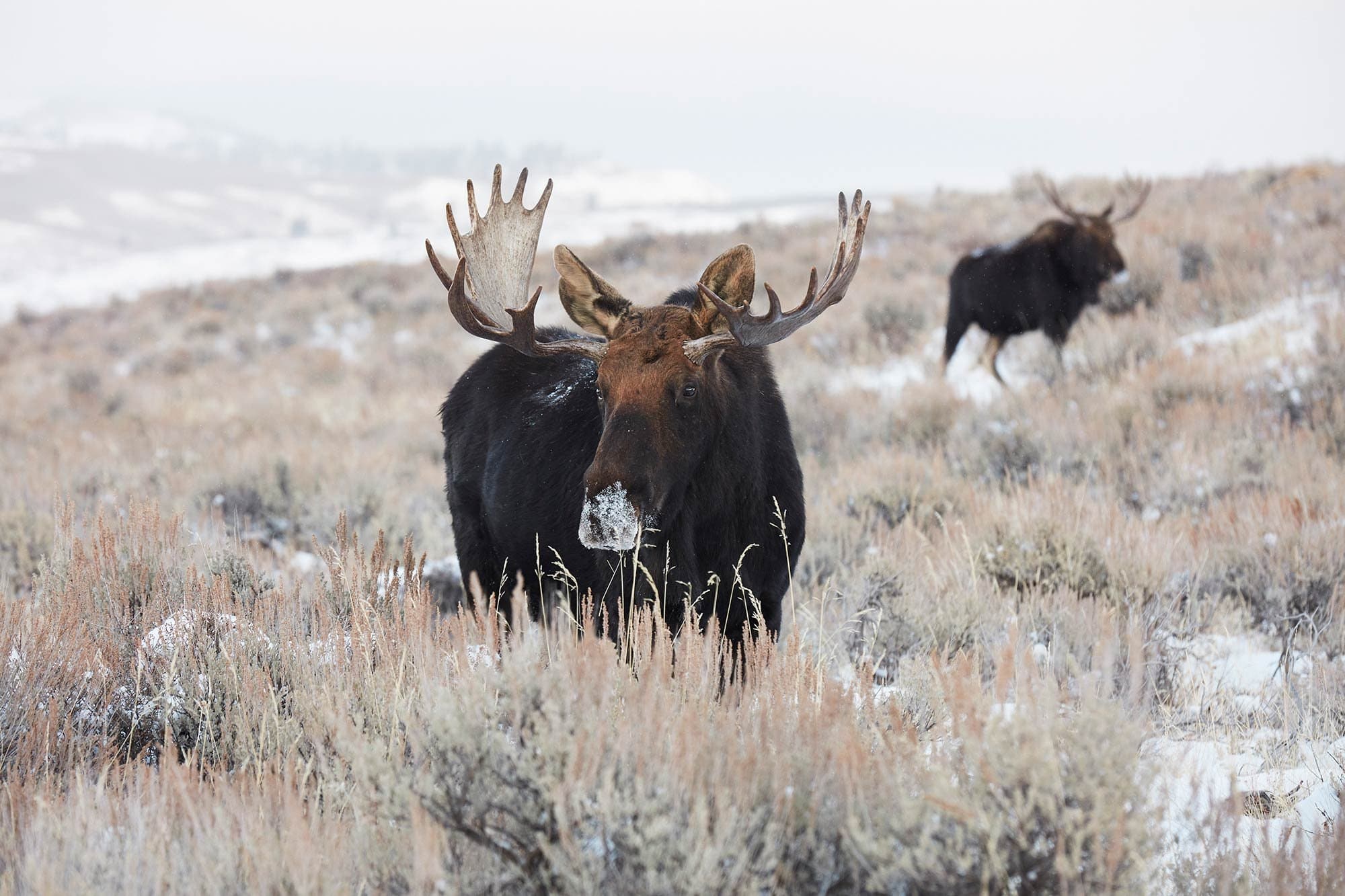
Moose are the largest member of the deer family — a bull can stand seven feet at the shoulder and weigh 1,200 pounds. They are also, contrary to their grocery-store mascot vibe, capable of running thirty-five miles per hour and aggressively territorial in calving season. People are more often charged by a moose in Wyoming than by a bear.
The good news: spotting one is easier than spotting almost anything else in the park. They are large, dark, and on a predictable schedule. Here is what we tell our guests.
Where
The single highest-probability spot in the valley is the willow flats along the Snake River and its tributaries — Flat Creek, Spread Creek, Pacific Creek. Moose are obligate willow-eaters in the morning. Find a creek bend with mature willow stands, sit twenty minutes, and you have an 80% chance.
Specific spots we send guests:
· Schwabacher Landing — dawn, year-round. The river bend below the parking lot is a moose factory.
· Moose-Wilson Road — slow drive at sunset, especially late summer. The willow corridor is the densest in the park.
· Pacific Creek (off Highway 191) — the underrated one. Better light than Schwabacher, fewer cars.
· Our back lawn — we are not joking. We had moose on the property three of the last six mornings. The cottonwoods that line our north edge are exactly the kind of cover they like.
When
Dawn and dusk. Moose are crepuscular — most active in the soft light at either end of the day. In Jackson Hole that means 5:30 to 7:30 AM in summer (6:30 to 8:00 in shoulder season), and the last hour before sunset.
Mid-day moose are bedded in willow shade and you will not see them. Don't waste your sunrise on a moose hunt in the wrong location.
How (and the safety part)
Stay 75 feet away. That is roughly two car lengths. Closer than that and a moose will react — and a reacting moose is a charging moose. They look slow. They are not.
If a moose lays its ears back, drops its head, or starts walking toward you with intent: back away. Do not run. Do not climb a tree (yes, moose can reach you in a tree). Put a large object — a vehicle, a thick trunk — between you and the moose, and let it pass.
Not to be confused with
Elk are smaller, lighter brown, have a creamy rump patch, and travel in herds. Moose are huge, dark brown to black, with a distinctive shoulder hump and a bell of skin under the throat. Bulls have palmate (flat, hand-shaped) antlers. Elk bulls have branching antlers. If you see a herd, it's elk. If it's alone and it makes you feel small, it's a moose.
What to bring
A long lens — 200mm minimum, 400mm if you have it. Binoculars. A thermos of coffee (the chef will fill it at breakfast). Layered warmth — the valley runs forty degrees colder at dawn than it does at noon. A notebook, if you're that kind of person.
Spotted one? Tell the innkeeper at breakfast. We track the back-lawn sightings on a clipboard in the great room. It's the most important document in the building.
Bentwood Inn · Wilson, Wyoming. Field notes from the front porch.